How do you know if you have Roma (Gypsy) ancestry?
Many families carry a story of Roma heritage but no records to prove it. A DNA test can now show the tell-tale mix of South Asian, Middle Eastern and European ancestry that points to Roma roots — and RomanyDNA lets you explore it with the raw DNA you already have.
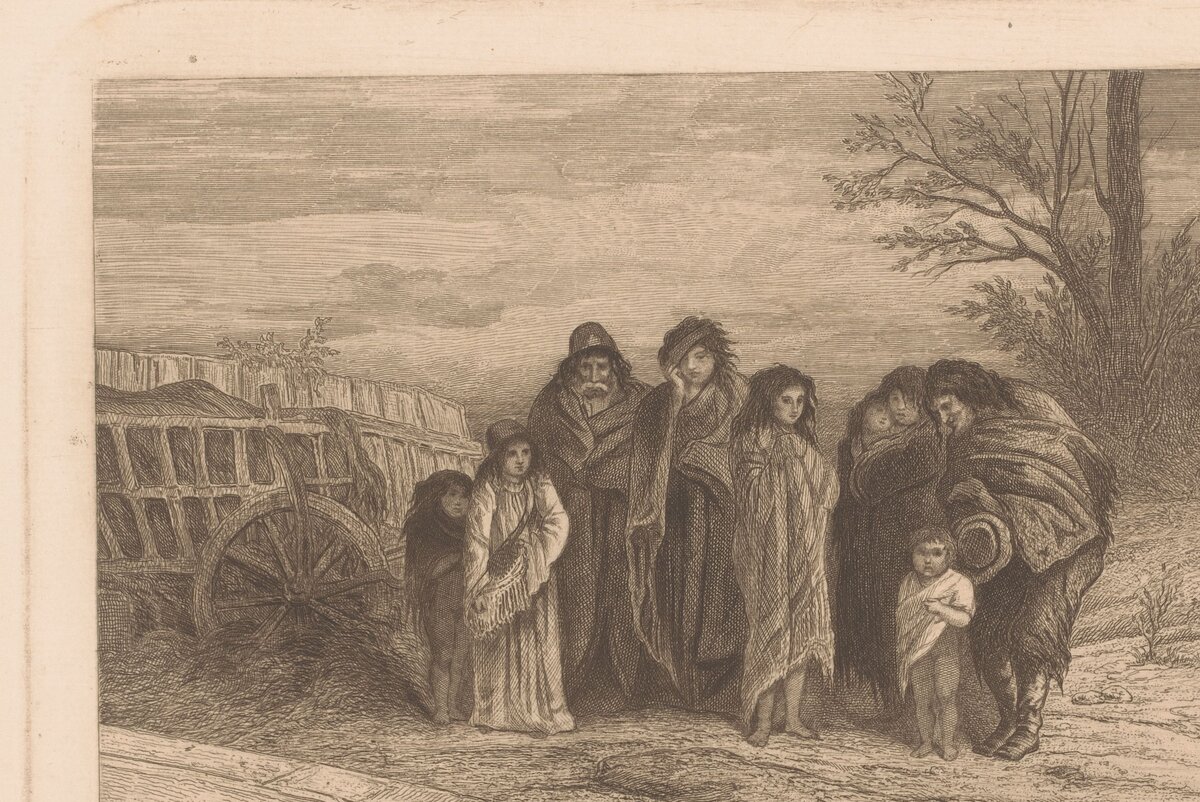
19th-century etching of a Roma family — Rijksmuseum (public domain).
What Roma ancestry looks like in your DNA
Historians trace the Roma people from the Indian subcontinent, through the Middle East, into Europe around the year 1500. As they travelled they carried their DNA with them and, over the centuries, mixed to varying degrees with the populations they met. That history leaves a recognisable signature: a Roma individual commonly shows a blend of South Asian, Middle Eastern and one or more European ethnicities.
If your report indicates a likely origin in Northwestern India together with European ancestry, there is a strong possibility of Roma ancestry. The exact percentages vary enormously between individuals and families, because some Roma groups intermarried within their own communities while others mixed more freely with local populations.
Why the Roma genetic signature is distinctive
Genetic studies have found surprisingly few prototypical lines from the Indian subcontinent among European Roma, which suggests they descend from a relatively small founding population. That makes the Roma genetic signature easier to identify in modern testing — and it is why a Roma ancestry result often looks quite different from a general "South Asian" or "European" result.
How to explore Roma ancestry with the DNA you already have
- Upload your raw data. RomanyDNA reads the raw file from AncestryDNA, 23andMe, MyHeritage, LivingDNA or Family Tree DNA — no new test needed.
- Look at your admixture. The ancestry estimate breaks your DNA into reference populations, so you can see the South Asian, Middle Eastern and European components together.
- Find your DNA matches. Shared centimorgans (cM) and segments reveal how closely you are related to other members and can confirm a Roma line.
- Use the chromosome browser. See exactly which chromosome segments you share with a match, and which ancestors they came from.
- Combine DNA with records. Build a family tree and attach the matches and segments you confirm, so your genetic and documentary evidence reinforce each other.
Start exploring your Roma ancestry
Why Roma DNA matches can look "too close": endogamy explained
If you compare Roma results with those of friends from outbred families, one thing stands out: Roma testers often share unusually large amounts of DNA with people who turn out to be only distant cousins. The reason is endogamy — marriage within the community over many generations.
When your mother's and your father's families both descend from the same small founding population, the same stretch of DNA can reach you twice — once down each side of your tree. Geneticists call this a double segment (or IBD2, "identical by descent on both copies"). In an outbred family double segments are essentially limited to full siblings; in an endogamous family they appear between much more distant relatives.
The practical effects for Roma research are:
- Shared cM runs high. The relationship ranges published by the testing companies assume an outbred family and no "pedigree collapse", so a Roma match can look like a 2nd cousin when they are really a 4th cousin or more.
- More, and longer, shared segments. Endogamy produces many shared segments, so segment counts are less discriminating than usual.
- Double segments are not a "close relative" signal. IBD2 appears between distant Roma cousins, so it cannot be used on its own to prove a close relationship.
- Long runs of homozygosity (ROH). A Roma kit often shows long ROH — stretches where both chromosome copies are identical. This is a normal signature of community endogamy, not necessarily evidence that your parents were closely related.
What to do about it. Treat cM totals as an upper bound on closeness rather than an answer. Lean on the largest shared segment, use triangulation to confirm that several matches share the same segment, build your family tree, and use tools that let you adjust for endogamy. RomanyDNA flags endogamy per kit and offers endogamy-aware options in the matching, clustering and WATO tools.
Understanding your results
Ethnicity estimates depend on the reference database a company uses and on its matching algorithms, so different providers can give different results for the same person. Smaller populations are harder to resolve exactly, which is why Roma ancestry is sometimes reported as a broad "South Asian", "Balkan" or "Middle Eastern" region rather than as Roma specifically. Your results are also only going to improve with time as databases grow — so keep revisiting your ancestry and genealogy as new matches appear.
DNA and cultural heritage
There is genetic ancestry, and there is cultural heritage, and the two do not always match. Many people throughout the centuries embraced a travelling way of life without being of Roma ethnicity, and genetic analysis will not pick those cases up. When DNA is combined with family stories and historical records, it helps paint a much fuller picture of where you come from.
Frequently asked questions
How do I know if I have Roma ancestry?
Roma ancestry usually appears in a DNA test as a distinctive mix of South Asian (often Northwestern Indian), Middle Eastern and one or more European populations. If your ethnicity report shows a likely origin in Northwestern India alongside European ancestry, there is a strong possibility of Roma ancestry. DNA matches and family records help confirm it.
What DNA do Roma people have?
The Roma people left the Indian subcontinent and moved through the Middle East into Europe, arriving in Europe around the 1500s. As they travelled they mixed, to varying degrees, with local populations. As a result Roma DNA is typically a blend of South Asian, Middle Eastern and European ancestry rather than a single population.
Which DNA test is best for Roma ancestry?
The best test is the one with a large, well-sampled reference database, because smaller ethnic groups are harder to resolve. You do not need a new test: RomanyDNA reads the raw data file you already downloaded from AncestryDNA, 23andMe, MyHeritage, LivingDNA or Family Tree DNA and compares it against every kit on the site.
Can a DNA test prove that I am Roma?
No. A DNA test can show genetic ancestry, but being Roma is also a cultural and community identity that genetics cannot measure. Many people adopted a travelling way of life without Roma ancestry, and many Roma have mixed ancestry. DNA is most useful when combined with family stories, records and research.
Is the term Gypsy correct?
Roma or Romani is the preferred term. Gypsy is a widely used search term but is often considered a slur, so it is best avoided in everyday use. This page mentions it only because many people search for Roma ancestry using that word.
Why can Roma ancestry be hard to detect?
Roma people descend from a relatively small founding population, so their genetic signature is distinctive but can be diluted by generations of mixing with local European populations. Smaller reference panels and different matching algorithms also mean estimates vary between testing companies, and results improve as databases grow.
Why do I share so much DNA with distant Roma cousins?
Because of endogamy. Many Roma and Romani families married within the community for generations, so both of your parents can descend from the same ancestors. When the same DNA reaches you through both your mother and your father, you share more centimorgans (cM), more segments and often double (IBD2) segments with a relative who is actually quite distant. The relationship ranges used by the testing companies assume an outbred family, so in Roma data they tend to read too close. Use the largest shared segment, triangulation and your family tree — not the cM total alone — to judge how you are related.